
AMFI Registered Mutual Fund Distributor

Imagine this.
You have built a mutual fund portfolio over several years. It is meant for your long-term goals, perhaps retirement, your child’s education, a business opportunity or simply financial security.
Then an unexpected requirement comes up.
You need ₹5 lakh. Or ₹10 lakh. Or perhaps a larger amount for a short period.
Your first thought may be:
“Should I redeem my mutual funds?”
Not necessarily.
If the requirement is temporary and your investments are otherwise aligned with your long-term objectives, a loan against mutual funds can be an alternative worth considering.
Instead of selling your mutual fund units, eligible investments can be pledged/lien-marked as security against a loan or overdraft facility. Depending on the lender and the eligible securities, you can access liquidity while continuing to hold the investments.
But, as with any borrowing decision, the question isn’t simply whether you can borrow.
The more important question is:
Should you borrow against your investments, and does it make sense for your particular situation?
A Loan Against Mutual Funds (LAMF) allows an investor to use eligible mutual fund units as collateral for borrowing.
Instead of redeeming the mutual fund investment, the units are pledged or lien-marked in favour of the lender.
The lender then provides a borrowing limit based on the value and type of eligible mutual funds.
For example, the lender may assign a particular loan-to-value (LTV) percentage to equity and debt mutual funds.
Current lender examples show that the LTV can differ materially between equity and debt funds. One lender currently states up to 50% of NAV for eligible equity mutual funds and up to 80% for eligible debt mutual funds, subject to its terms and approved list.
This is important because:
₹20 lakh of mutual funds does not necessarily mean you can borrow ₹20 lakh.
The amount depends on the eligible value of the securities, the applicable LTV, the lender’s credit policies and other conditions.
This is perhaps the most important reason to consider this facility.
Suppose you have accumulated ₹30 lakh in mutual funds over several years.
You suddenly need ₹8 lakh for a business requirement that you expect to repay within 12 months.
One option is to redeem ₹8 lakh worth of investments.
But that means selling investments that may have been intended for a much longer period.
The alternative is to borrow against eligible units and repay over time.
This can separate your short-term liquidity needs from your long-term investment strategy.
It doesn’t mean borrowing is automatically better.
It means selling an investment shouldn’t always be the first response to a temporary cash-flow requirement.
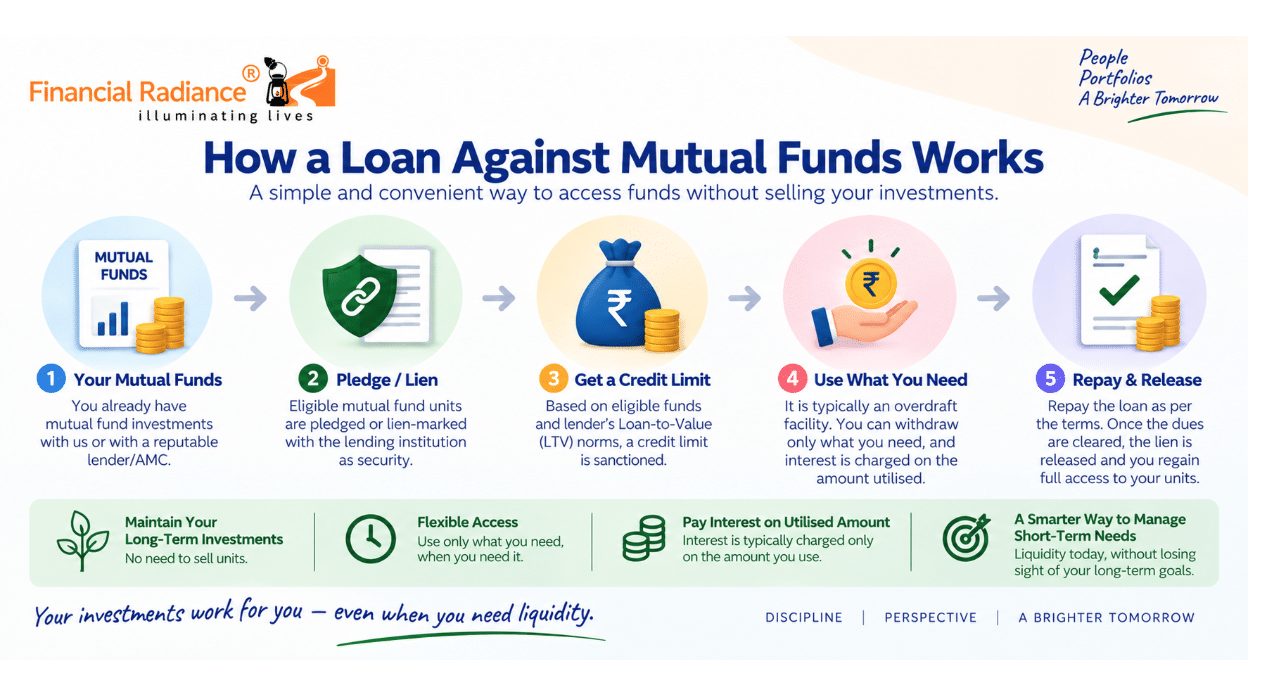
The broad process is relatively straightforward.
Not every mutual fund necessarily qualifies.
Lenders typically maintain an approved list and determine eligibility based on the security type and their internal lending policies.
The lender applies the relevant LTV to the eligible value of your mutual fund holdings.
The available amount can therefore vary depending on whether the collateral consists of equity funds, debt funds, or other eligible schemes.
The eligible mutual fund units are pledged or lien-marked in favour of the lender.
You continue to own the investment, but it remains encumbered until you repay the loan and the lien is released.
Many facilities are structured as an overdraft.
This can be useful because you may not need to withdraw the entire sanctioned limit immediately.
For example, if your sanctioned limit is ₹10 lakh but you need only ₹4 lakh, you may utilise only ₹4 lakh, subject to the facility’s terms.
This is an important distinction between an overdraft-style facility and a conventional lump-sum loan.
For example, one lender currently states that it charges interest on the amount utilised for the period it is utilised.
So if you have a ₹10 lakh limit but use only ₹4 lakh, interest is generally calculated on the utilised amount for the number of days it is used, subject to the lender’s terms.
Selling mutual funds can have several consequences.
You may:
A loan against mutual funds can potentially provide liquidity without requiring immediate redemption of the pledged units.
However, the mutual fund investment remains exposed to market movements.
This is important.
The loan does not protect you from market risk.
If the market value of the pledged securities falls significantly, the available collateral value can fall as well. Depending on the facility, this may require additional collateral or repayment to bring the account back within the permitted limit. One lender, for example, explicitly notes that a fall in mutual fund value can reduce the available credit limit and may require pledging additional units or repaying the excess amount.
Several situations may warrant consideration.
A business owner may need working capital for a few months but may not want to liquidate long-term investments.
Perhaps a large receivable is expected in a few months, but money is required today.
A medical expense, education-related payment or another significant requirement can create a temporary liquidity need.
Sometimes an investment or business opportunity requires funds within a short timeframe.
The key is to have a clear purpose and repayment strategy.
A loan against mutual funds is not free money.
It is borrowing secured against your investments.
Caution matters most in several situations.
Taking a loan against investments to fund an expensive holiday, luxury purchase, or lifestyle upgrade can create unnecessary financial pressure.
You are effectively borrowing against assets that may have taken years to build.
If you don’t know how you will repay the loan, the problem isn’t liquidity anymore.
It is leverage.
Using borrowed money to invest in equity markets can magnify both gains and losses.
That introduces leverage into an investment portfolio and is a very different proposition from borrowing for a temporary cash-flow requirement.
If most of your pledged assets are volatile investments, a market correction can reduce the collateral value at the same time that you still have the loan outstanding.
That combination needs careful consideration.
Always compare the loan cost with the alternatives available to you.
Don’t assume that because the loan is secured, it is automatically inexpensive.
Rates and charges vary between lenders and over time.
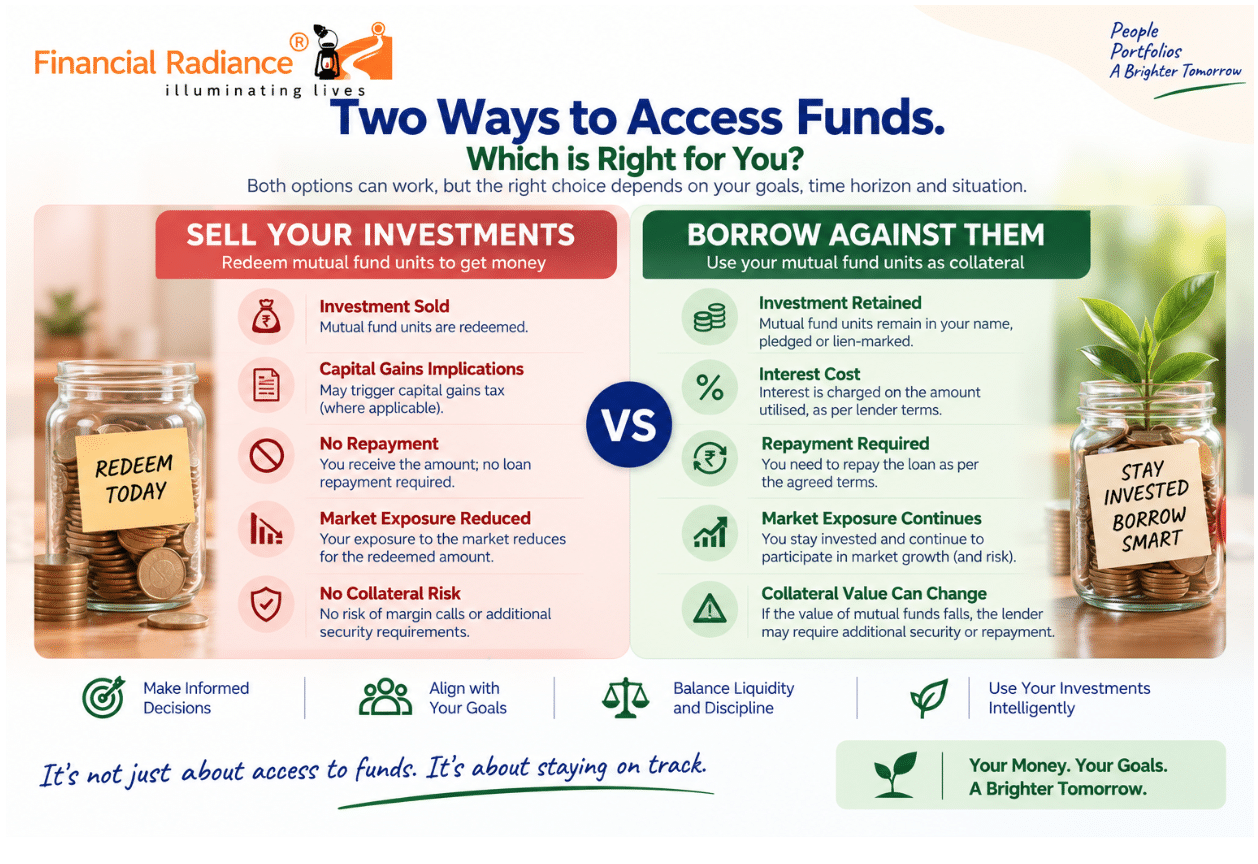
Consider the two approaches conceptually.
Redeem mutual funds | Loan against mutual funds | |
Investment sold | Yes | No, units remain pledged |
Liquidity | Immediate after redemption | Subject to loan approval and facility |
Borrowing cost | No interest | Interest applies |
Market exposure | Reduced on redeemed units | Continues on pledged units |
Capital gains implications | May arise | Borrowing itself is not a redemption |
Repayment required | No loan repayment | Yes |
Market risk | Lower after redemption | Continues |
Collateral risk | None | Yes |
Neither option is universally better.
The right choice depends on why you need the money, for how long, your portfolio, the borrowing cost and your ability to repay.
This is an area where investors need to be careful.
A loan against mutual funds is fundamentally different from redeeming mutual fund units.
A redemption transfers units and can create a capital gain or loss, depending on the circumstances.
A borrowing arrangement does not itself represent a sale of the pledged units.
However, the tax treatment of interest depends on how the borrowed money is used and the applicable tax provisions.
For example, the tax treatment may differ depending on whether the borrowing is used for business purposes or personal expenditure.
Therefore, investors should not assume that the interest is automatically tax deductible.
The purpose of borrowing matters.
Where a tax deduction is important to the decision, it is sensible to obtain appropriate tax advice based on the specific use of the borrowed funds.
At Financial Radiance, I believe the discussion should begin here.
Not with:
“How much loan can I get?”
But with:
“Why do I need the money?”
There is a big difference between:
“I need ₹5 lakh for three months because a business receivable is delayed.”
and
“I need ₹5 lakh because I have been spending more than I earn.”
The first could potentially be a liquidity-management decision.
The second may require addressing the underlying cash-flow problem rather than simply adding another loan.
This is particularly important for long-term investors.
You may have selected your mutual funds around specific objectives and time horizons.
If you need money temporarily, you don’t necessarily want to disrupt that structure unnecessarily.
That is why I believe you should always consider financial decisions in the context of the overall portfolio.
The question isn’t simply whether your mutual fund has appreciated.
It is:
Only after answering these questions should you compare borrowing with redemption.
Suppose you have:
Mutual fund portfolio: ₹40 lakh
Short-term requirement: ₹6 lakh
Expected repayment: 6 to 9 months
If the portfolio is otherwise intended for a long-term goal, redeeming ₹6 lakh may disturb your investment strategy.
A loan against eligible mutual funds could potentially provide the required liquidity while allowing the investments to remain in place.
But now consider another investor:
Mutual fund portfolio: ₹15 lakh
Requirement: ₹10 lakh
Repayment ability: Uncertain
The second situation is very different.
The borrowing may create excessive leverage relative to the investment portfolio and repayment capacity.
The lesson is simple:
A loan’s suitability depends on the borrower, not merely the collateral.
This is perhaps the most important message of this article.
Having a ₹50 lakh investment portfolio does not mean you should borrow against it.
The availability of credit can sometimes create a temptation to spend.
A credit facility should ideally be treated as a liquidity tool, not an extension of your income.
The best use cases are generally situations with a genuine need, a defined amount, a reasonable cost, and a credible repayment plan.
Financial Radiance facilitates access to loans against eligible mutual fund investments, helping clients understand the process and evaluate whether this facility fits their requirements.
The lending institution provides the actual loan and determines the applicable interest rate, eligible mutual funds, LTV, loan amount, documentation, tenure, and other terms.
Our role is to help you look at the requirement in the context of your overall financial position and investment portfolio, rather than treating the loan as an isolated transaction.
If you already have substantial mutual fund investments and need temporary liquidity, it may be worth exploring whether borrowing against eligible investments makes more sense than redeeming them.
At the same time, if existing cash reserves, redeeming a portion of investments, or restructuring liabilities better address the requirement, consider those options as well.
The objective is not to borrow more.
The objective is to make the right liquidity decision without unnecessarily disturbing your long-term financial strategy.
If you would like to explore a loan against your mutual fund investments, get in touch with Financial Radiance to understand the process and whether it may suit your needs.
You can also explore our other services, including Investment Execution, Retirement Readiness, Personal Insurance, Business Insurance, Startup Investing, Estate Planning, NRI Investments, Debt Management, Old Investments Retrieval and Tax Planning.
Yes. A loan against mutual funds generally involves pledging or lien-marking eligible mutual fund units as security rather than redeeming them. The exact process depends on the lender.
It depends on the lender, the type of mutual fund, the eligible value of the units and the applicable LTV. Current lender examples show different LTVs for equity and debt funds.
For an overdraft-style facility, interest can be charged on the amount actually utilised and for the period it is utilised, subject to the lender’s terms.
Yes. Your mutual fund remains exposed to market movements. If its value falls, the available collateral value may reduce, and the lender may require additional security or repayment depending on the facility’s terms.
There is no universal answer. The decision depends on the purpose and duration of the requirement, borrowing cost, tax implications, portfolio structure, market conditions and repayment capacity.
You can use a loan against mutual funds for eligible purposes, subject to the lender’s terms. Business use may also have different tax considerations, so you should clearly evaluate the purpose of the borrowing.
Once the applicable dues are cleared and the facility requirements are satisfied, the lender can release the lien/pledge according to its process.
If you found this useful, explore more insights on my website and stay updated.
👉 Follow my YouTube channel for practical investing guidance.
👉 Read more blogs on Financial Radiance.

“I need a loan urgently. If I go to Banks, they will take some time. I do not have time to even go to the Bank.”
“My CIBIL score is not good and I may not get the loan.”
“Currently markets are not doing well and I do not want to sell my mutual funds and shares. What to do?”
“Interest rates are so high. Where can I get loan at a cheaper interest rate?”
“I need flexibility. I am expecting a payment in the next few weeks. I need a loan only for short duration and I do not want to pay foreclosure charges.”
We have a solution for you. Lien them and take a loan at just 10.25% p.a. interest rate. All within 15 minutes!
Maximum loan eligibility is 45% for equity mutual funds and 80% for debt funds. ELSS (tax saver) funds under lock-in and closed-ended funds are not considered.
Interest is charged monthly only for the days you take the loan. Part-payment and loan foreclosure can be done online at any time.
Once you have created a line of credit, you can take the loan at any time (subject to that limit) or repay it online instantly.
Excellent option for business professionals who need a convenient line of credit available to them, always. The best part is that business professionals can also claim interest as a business expense for a tax deduction!
An excellent option for salaried professionals who are considering taking an expensive personal loan or credit card debt.
Contact us immediately to know the process, if interested. Taking a loan to fund your pleasures is never a good option. But if you must take a loan and have assets, this is certainly a very good option to consider.

Address
B 346, Victoria Drive, Paramount Golf Foreste, Opp. Sector Zeta 1, Greater Noida – 201306 Uttar Pradesh
Grievance Officer Name: Rajesh Minocha
Email: rajeshminocha@financialradiance.com
Contact: +91 98664 61113 | +91-120-4548926