
AMFI Registered Mutual Fund Distributor
Markets rarely move in a straight line.
Markets move through periods of strong growth, sharp corrections, uncertainty, and recovery. Yet one of the most difficult things for investors is not understanding that markets fluctuate. It is staying disciplined while they do.
Recently, I analysed the average holding periods and return outcomes across 453 client families of Financial Radiance.
The objective was simple: to understand whether there was any observable relationship between how long families had remained invested and the returns they had experienced.
The results were interesting.
And, more importantly, they reinforced something I have believed for many years:
Investing is not only about selecting investments. It is also about having the right goals, time horizon, risk appetite, asset allocation and behaviour.
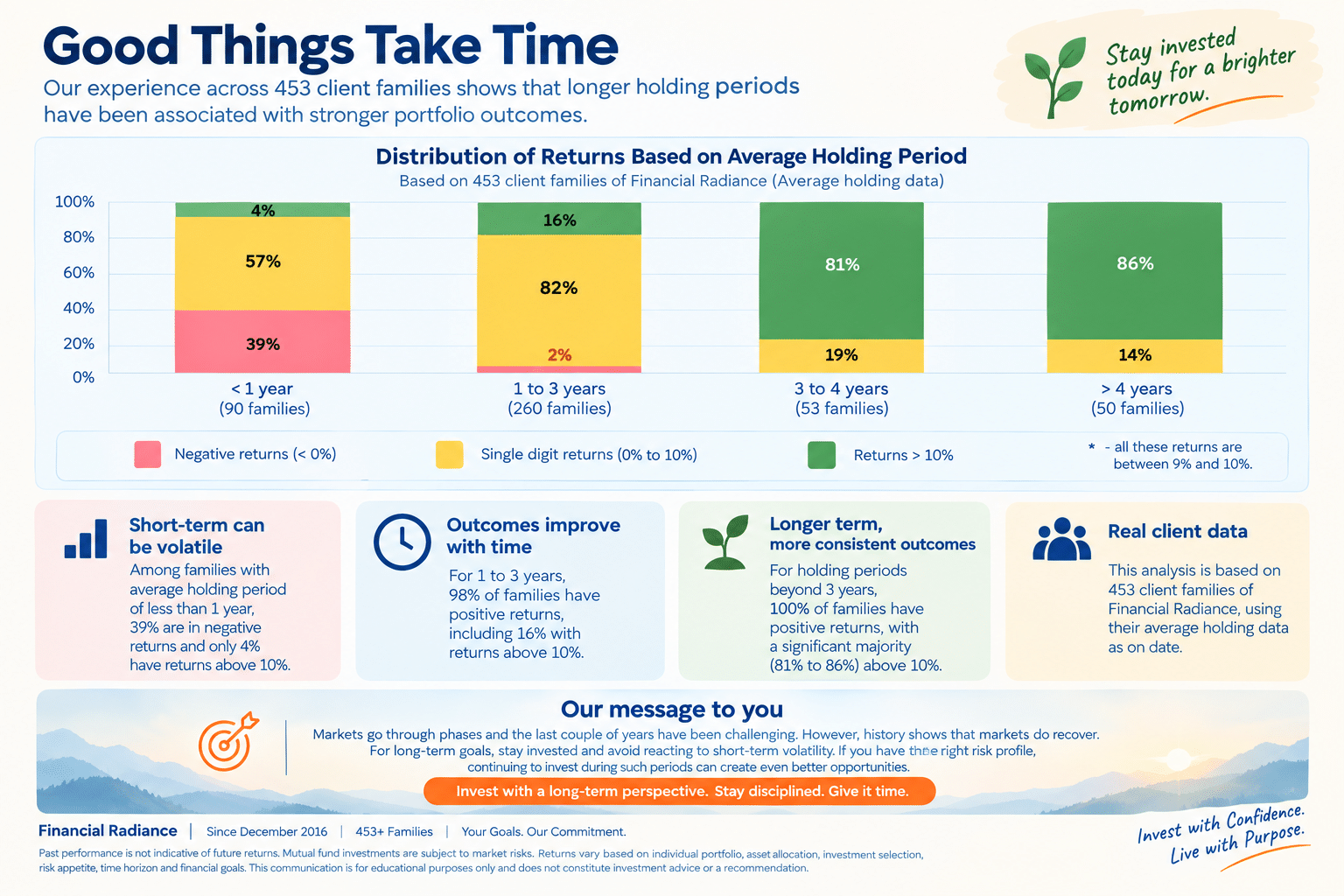
The analysis divided 453 client families by average holding period.
Average holding period | Families | Negative returns | 0–10% returns | >10% returns |
Less than 1 year | 90 | 39% | 57% | 4% |
1–3 years | 260 | 2% | 82% | 16% |
3–4 years | 53 | 0% | 19% | 81% |
More than 4 years | 50 | 0% | 14%* | 86% |
*The returns in this 14% were between 9% and 10%.
The pattern is quite striking.
Among families with an average holding period of less than one year, 39% had negative returns, while only 4% had returns above 10%.
This analysis shows an association, not causation.
It does not prove that simply holding an investment for four years will automatically produce a return above 10%.
The sample sizes are also different across the holding-period groups, and this is an analysis of our client portfolio experience rather than a controlled academic study.
Many factors influence portfolio outcomes: asset allocation, risk appetite, market conditions, investment choices, cash flows, entry points, redemptions, and investor behaviour, among others.
So I would not interpret this data as a promise about future returns.
I would interpret it as a useful behavioural signal.
One of the most important principles in investing is matching the investment to the goal and its time horizon.
Money required in the near term should not necessarily be exposed to the same level of market volatility as money meant for a long-term goal.
If an investor has a five-, seven-, or ten-year objective, judging the portfolio after six months can lead to behaviour that differs completely from what’s required to achieve the objective.
This is why I believe the first question should not be:
“Which fund should I invest in?”
It should be:
“What is this money meant to achieve, when will I need it, and how much volatility can I realistically tolerate along the way?”
The investment strategy should follow from that.
Time horizon alone is not enough.
Two investors may have exactly the same ten-year goal but completely different abilities and willingness to tolerate volatility.
One may be comfortable seeing a portfolio fall temporarily. Another may panic after a 10–15% decline and redeem at precisely the wrong time.
That is why risk appetite and risk capacity matter.
An investment that looks attractive on paper can become a poor investment experience if it doesn’t match the investor’s ability to stay invested through difficult periods.
The best portfolio is therefore not necessarily the one with the highest expected return.
It is the one that an investor can actually stay with.
This is another area that deserves more attention.
Investors often compare the return of a mutual fund with the return they see in their own portfolio and wonder:
“Why is my return lower than the fund’s return?”
There can be perfectly logical reasons.
An investor may have invested at different points in time, redeemed during a correction, switched after a period of underperformance, paused SIPs, moved money between categories or taken other actions during periods of uncertainty.
As a result, the investor’s actual experience can differ significantly from a fund’s published return.
Another important point in our analysis is that portfolio return reflects the investor’s actual experience, including the impact of past investments and redemptions.
A fund’s published return is about the fund.
Your portfolio return is about your journey.
Those are not necessarily the same thing.
I strongly believe you should review portfolios periodically.
But a review does not automatically mean a transaction.
This distinction is often missed.
A portfolio may be reviewed because:
But simply seeing that one fund has delivered a lower return than another is not, by itself, a reason to act.
Past returns are already known.
They tell us what happened.
They do not tell us what will happen next.
Another lesson from working with portfolios over many years is that not every investment needs to perform equally well at the same time.
A portfolio is constructed for a purpose.
Different asset classes and fund categories can play different roles — growth, diversification, stability or risk management.
If everything in the portfolio behaves exactly the same way, there may actually be very little diversification.
For example, an equity category that has underperformed recently may still have a role within an appropriately constructed portfolio. Similarly, an investment that has performed exceptionally well may eventually become too large a part of the portfolio.
This is why I prefer looking at the overall portfolio rather than judging every fund in isolation.
Perhaps the most important portfolio-level consideration is asset allocation.
How much is invested in equity?
How much in fixed income or other relatively stable assets?
How diversified is the portfolio?
Does the allocation reflect the investor’s goals, time horizon and risk appetite?
These questions are often more important than asking which fund delivered the highest return last year.
A well-constructed portfolio will inevitably contain investments that perform differently at different points in the market cycle.
That is not necessarily a problem.
It can be part of the design.
One of the biggest challenges investors face is the temptation to do something when markets become uncomfortable.
Markets fall → concern increases → portfolio is checked more frequently → recent performance is compared → a decision is taken → the investment is changed.
Sometimes the change is necessary.
But sometimes it is simply a reaction to what has already happened.
That distinction can make a significant difference over a long investment journey.
The irony is that investors often spend considerable time trying to find the right investment and much less time thinking about how they themselves will behave when that investment falls.
The 453-family analysis has reinforced my belief that investing needs to be viewed at the portfolio level and over the appropriate time horizon.
The objective is not to predict every market movement.
It is to build an approach around:
Goals → Time Horizon → Risk Appetite → Asset Allocation → Investment Selection → Monitoring → Behaviour
And importantly, monitoring does not always mean action.
Sometimes the most valuable decision is to stay with a well-thought-out strategy rather than react to short-term noise.
This is also where a good professional can add value.
Not by predicting which fund will be the next winner.
Not by trying to time every market movement.
But by helping investors step back, look at the bigger picture, understand the portfolio in context and, perhaps most importantly, avoid unnecessary decisions driven by short-term performance or emotion.
A CFP professional with a strong understanding of investments, risk and investor behaviour can bring considerable value to that process.
The bigger lesson
The message from our data is simple:
Good things take time.
Long-term investing does not eliminate risk. It does not guarantee returns. And it certainly does not mean every investment will perform well all the time.
What it can do is give a well-constructed portfolio time to work through different market cycles.
For investors, the real challenge is often not finding something to invest in.
It is having the discipline to remain invested when the journey becomes uncomfortable, while still being willing to make changes when the underlying goals, risks or portfolio structure genuinely require them.
Invest with a long-term perspective. Review with discipline. Act with purpose. And give good investments the time they deserve.

This analysis is based on the average holding-period and return data of 453 client families of Financial Radiance as available at the time of analysis. It is an internal observational analysis and should not be interpreted as a guarantee or prediction of future returns. Individual portfolio outcomes vary based on asset allocation, investment selection, cash flows, market conditions, risk appetite, time horizon and investor behaviour.
Past performance is not indicative of future returns. Mutual fund investments are subject to market risks. This communication is for educational purposes only and does not constitute investment advice or a recommendation.
If you found this useful, explore more insights on my website and stay updated.
👉 Follow my YouTube channel for practical investing guidance.
👉 Read more blogs on Financial Radiance.

Address
B 346, Victoria Drive, Paramount Golf Foreste, Opp. Sector Zeta 1, Greater Noida – 201306 Uttar Pradesh
Grievance Officer Name: Rajesh Minocha
Email: rajeshminocha@financialradiance.com
Contact: +91 98664 61113 | +91-120-4548926